faber-tweann
View SourceTopology and Weight Evolving Artificial Neural Networks for Erlang




Evolutionary neural networks that evolve both topology and weights, now with Liquid Time-Constant (LTC) neurons for adaptive temporal processing. Based on DXNN2 by Gene Sher.
Highlights
- First TWEANN library with LTC neurons in Erlang/OTP
- CfC closed-form approximation - ~100x faster than ODE-based LTC
- Rust NIF acceleration - Native implementations of fitness statistics, novelty search, selection and network evaluation (speedup not yet measured; see below)
- Pure Erlang reference implementation - Selected explicitly, held in agreement with the native path by a conformance test
- Hybrid networks - Mix standard and LTC neurons in the same network
- Production ready - Comprehensive logging, error handling, and process safety
Quick Start
%% Add to rebar.config
{deps, [{faber_tweann, "~> 2.0"}]}.

%% Create and evolve a standard network
genotype:init_db(),
SpecieId = genotype:generate_id(specie),
AgentId  = genotype:generate_id(agent),
Constraint = #constraint{morphology = xor_mimic},
genotype:construct_Agent(SpecieId, AgentId, Constraint),
genome_mutator:mutate(AgentId).

%% Use LTC dynamics directly
{NewState, Output} = ltc_dynamics:evaluate_cfc(Input, State, Tau, Bound).
LTC Neurons
Liquid Time-Constant neurons enable adaptive temporal processing with input-dependent time constants:
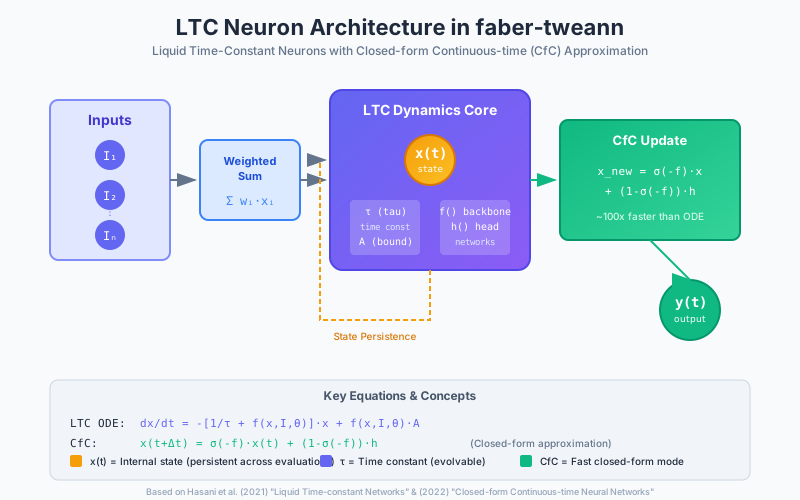
%% CfC evaluation (fast, closed-form)
{State1, _} = ltc_dynamics:evaluate_cfc(1.0, 0.0, 1.0, 1.0),
{State2, _} = ltc_dynamics:evaluate_cfc(1.0, State1, 1.0, 1.0).
%% State persists between evaluations - temporal memory!
Key equations:
- LTC ODE:
dx/dt = -[1/τ + f(x,I,θ)]·x + f(x,I,θ)·A - CfC:
x(t+Δt) = σ(-f)·x(t) + (1-σ(-f))·h(100x faster)
See the LTC Neurons Guide for details.
Documentation
- Installation - Add to your project
- Quick Start - Basic usage
- LTC Neurons - Temporal dynamics
- LTC Usage Guide - Practical examples
- Architecture - System design
- Full Documentation - All guides and module docs
Features
Neural Network Evolution
- Topology Evolution: Networks add/remove neurons and connections
- Weight Evolution: Synaptic weights optimized through selection
- Speciation: Behavioral diversity preservation (NEAT-style)
- Multi-objective: Pareto dominance optimization
LTC/CfC Neurons
- Temporal Memory: Neurons maintain persistent internal state
- Adaptive Dynamics: Input-dependent time constants
- CfC Mode: ~100x faster than ODE-based evaluation
- Hybrid Networks: Mix standard and LTC neurons
Production Quality
- Process Safety: Timeouts and crash handling
- Comprehensive Logging: Structured logging throughout
- Rust NIF (optional): High-performance network evaluation
- ETS Storage: Fast in-memory genotype storage (see ROADMAP.md for planned Mnesia persistence)
Native Acceleration
Rust NIFs for the numeric hot paths ship with this package and are built from source at compile time. A Rust toolchain is required.
There is one edition. The faber-nn-nifs package was absorbed into
faber_tweann in v2.0.0; if you depended on faber_nn_nifs directly, depend on
faber_tweann instead.
tweann_nif:impl().       %% faber_nn_nifs | tweann_nif_fallback
tweann_nif:is_loaded().  %% true when the native path is active
The native path is the default. If the library is missing or fails to load, faber_tweann raises on first use rather than quietly falling back. To use the pure Erlang implementation deliberately:
[{faber_tweann, [{nif_impl, fallback}]}].See the Native Acceleration guide.
On performance claims: earlier versions of this README quoted speedups between 30x and 200x, while the faber-nn-nifs README quoted 10-15x for the same code. Neither figure was backed by a committed measurement, and the two were mutually inconsistent. No speedup figures are published here until a benchmark runs and its output is committed.
test/benchmark/bench_nif_vs_erlang.erlexists for this purpose.
Architecture
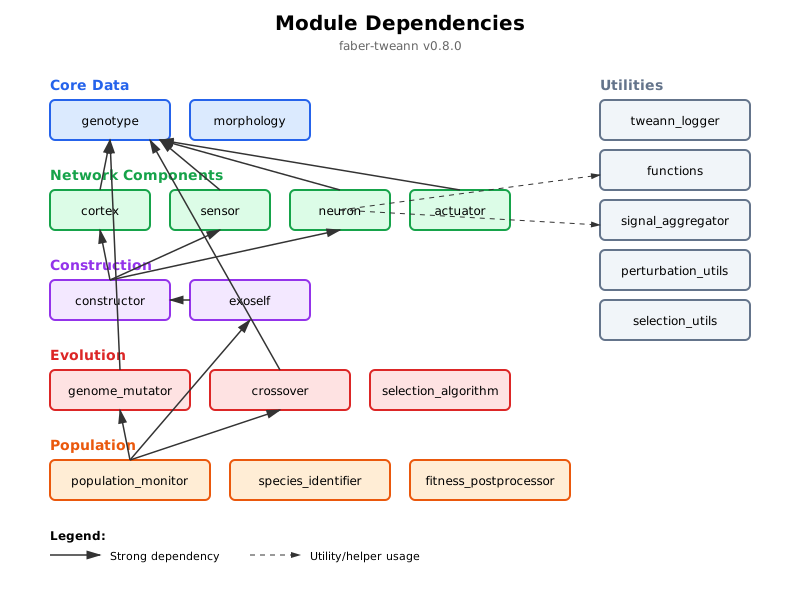
Process-based neural networks with evolutionary operators. See Architecture Guide for details.
Testing
rebar3 eunit          # Unit tests (971 tests)
rebar3 dialyzer       # Static analysis
rebar3 ex_doc         # Generate documentation
Academic References
TWEANN/NEAT
Sher, G.I. (2013). Handbook of Neuroevolution Through Erlang. Springer.
- Primary reference for DXNN2 architecture and Erlang implementation patterns.
Stanley, K.O. & Miikkulainen, R. (2002). Evolving Neural Networks through Augmenting Topologies. Evolutionary Computation, 10(2), 99-127.
- Foundational NEAT paper introducing speciation and structural innovation protection.
Stanley, K.O. (2004). Efficient Evolution of Neural Network Topologies. Proceedings of the 2002 Congress on Evolutionary Computation (CEC).
- Complexity analysis and efficiency improvements for topology evolution.
LTC/CfC Neurons
Hasani, R., Lechner, M., et al. (2021). Liquid Time-constant Networks. Proceedings of the AAAI Conference on Artificial Intelligence, 35(9), 7657-7666.
- Introduces adaptive time-constant neurons with continuous-time dynamics.
Hasani, R., Lechner, M., et al. (2022). Closed-form Continuous-time Neural Networks. Nature Machine Intelligence, 4, 992-1003.
- CfC closed-form approximation enabling ~100x speedup over ODE-based LTC.
Weight Initialization
- Glorot, X. & Bengio, Y. (2010). Understanding the difficulty of training deep feedforward neural networks. Proceedings of AISTATS.
- Xavier initialization theory used for network weight initialization.
Evolutionary Algorithms
Holland, J.H. (1975). Adaptation in Natural and Artificial Systems. MIT Press.
- Foundational text on genetic algorithms.
Yao, X. (1999). Evolving Artificial Neural Networks. Proceedings of the IEEE, 87(9), 1423-1447.
- Comprehensive survey of neuroevolution approaches.
ONNX Export
- ONNX Consortium (2017-present). Open Neural Network Exchange.
- Open standard for neural network interoperability enabling cross-platform inference.
Related Projects
Faber Ecosystem
macula - HTTP/3 mesh networking platform with NAT traversal, Pub/Sub, and async RPC. Enables distributed neuroevolution across edge devices.
faber_neuroevolution - Population-based evolutionary training engine that orchestrates neural network evolution using this library.
Inspiration & Related Work
DXNN2 - Gene Sher's original TWEANN implementation in Erlang, the foundation for this library.
NEAT-Python - Popular Python implementation of NEAT.
SharpNEAT - High-performance C# NEAT implementation.
PyTorch-NEAT - Uber's PyTorch-based NEAT implementation.
LTC/CfC Reference Implementation - MIT/ISTA reference implementation of LTC networks.
License
Apache License 2.0 - See LICENSE
Credits
Based on DXNN2 by Gene Sher. Adapted with LTC extensions by R.G. Lefever.